Visas to Bhutan
All citizens except those from India, Bangladesh, and the Maldives require a visa to enter Bhutan. It requires a readable color copy of your passport, and the passport should have at least six months of validity from your Bhutan exit date. The visa fee is US$40 per person.
The tour’s full payment must be made before you arrive in Bhutan, as per the Tourism Council of Bhutan – TCB.
Visa procedures
To apply for the visa, you need to send clear copies of your passports to your travel agent in JPEG or PDF format via mail. Upon full tour payment receipt, the Tourism Council of Bhutan then issues the visa clearance letter to your travel agent, which in turn will send it to you.
Please bring this letter and show at the Paro International Airport in order to get your passport stamped with the actual Bhutan visa. Please note that the VISA service is not offered in Bhutan; travelers have to buy a full service package from the local tour operator.
A printed copy of the visa letter also needs to be shown during check-in at the Druk Air counter. Entering Bhutan overland via Phuentsholing or Samdrup Jokhar, one needs to present the visa letter at the immigration office.
Accommodation
There’s a wide selection of hotels in Bhutan from 3-star to world-class 5-star hotels in prominent places like Paro, Thimphu, Punakha, Gangtey, etc. 3-5 star hotel are officially government-approved hotels.
Besides, there are hundreds of standard and budget hotels scattered throughout Bhutan, including homestays farm house stays.
Travelers' daily cost includes stays at 3-star hotels and using 4-star or 5 star will require an additional premium. Top 5-star hotels in Bhutan include Le Méridien, Taj Tashi, Como Uma etc.
Meals
During the stay, all meals are included from breakfast to lunch and dinner. Breakfast and dinners will be at the hotels where travelers are staying, and lunch might be at the restaurant during the sightseeing tour.
However, on the last day of the tour, the travel agent is obliged to provide breakfast only, and any lunch/dinner will be travelers’ own. Meals in Bhutan include a mix of Indian and continental, including Bhutan special cuisines such as Ema Datshi, Momos, etc.
Transportation
Traveling in Bhutan is easy nowadays, with Bhutan rapidly developing its infrastructure on it’s road-system. Until 1961, traveling in Bhutan was quite difficult, with no proper means of transportation in the country.
One had to travel either on foot or on mule/horse back. After 1961, modern road construction began, with most of the districts and towns getting interconnected via roadways.
Nowadays, comfortable ground transport and public vehicles are accessible in major cities. Different luxurious cars, SUVs, buses and coaster buses are available for tourists.
Guides
Every guide in Bhutan must complete a training course so that visitors get high-quality professional service. Over 1000 licensed active tour guides are working in the country.
Guides specialize either in cultural or adventure tours. All Bhutanese guides are helpful and friendly and proficient in English.
Many guides have also learnt other languages like German, Japanese, Thai, or others for better communication with travelers from these countries. All tour operators must employ only registered and certified guides.
How to get to Bhutan
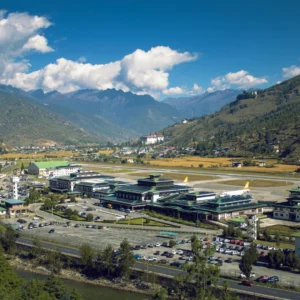
There are two options to get into Bhutan by air or by land. One can fly to Bhutan and land at the only international airport of Bhutan – the Paro International Airport.
Alternatively, by land, one can enter Bhutan via Phuentsholing from the west, connecting with Bagdogra Airport, Siliguri, West Bengal, or Kakarbhitta, Nepal. Gelephu is the entry point if you are travelling from the central region, and Samdrup Jongkhar from the east.
Exiting through Samdrup Jongkhar in southeast Bhutan connects you to Guwahati in India. From Guwahati, you may fly into other Indian cities like Delhi, Bombay, or Kolkata.
Even though Bhutan shares its border with Tibet, there are not treaties established yet to open the border crossing between these two countries.
Flights to Bhutan
Only two airlines connect Bhutan with the rest of the world: Druk Air (the national flag carrier) & Bhutan Airlines (Privately owned airline). These airlines fly into the Paro International Airport in Paro – the only international airport in Bhutan. They too fly from certain cities only, like Kathmandu, Delhi, Singapore, Bangkok, Kolkata, and Bagdogra.
Airline flight schedules change by season, but there are several flights per week from Kathmandu, New Delhi, Singapore, and Bangkok, either direct or via Dhaka, Kolkata, or Bagdogra.
Flights into Paro are dependent upon the weather conditions due to geographical location of Paro airport, so flight timings are subject to change. Therefore, all passengers are advised to maintain a minimum of 24 hours connection time to avoid disconnection.
Best time to visit Bhutan
The best time to visit Bhutan is spring (March-May) and Autumn/fall (September-November). Weather mostly remains clear during spring, when the mystifying beauty of nature can be witnessed, and varieties of flowers and plants bloom.
June-August is the summer season, and the monsoon starts in June. Fall (Sep-Nov) is another high season after spring, during when tourist arrives Bhutan for festivals like Thimphu Tshechu, Gangtey Tshechu, and Jambay Lhakhang Drup.
The winter season (Dec-Feb) isn’t crowded when temperature level goes down (even below freezing point), and Bhutan may see snowfall. Trekking won’t be possible at high elevations in winter due to snow.