
11-Day Bhutan Bumthang Cultural Tour

11 Days 10 Nights

The 11-Day Bhutan Bumthang Cultural Tour brings you to the cultural and spiritual heart of the country. This itinerary has the traveler praying at monasteries, visiting temples, and walking through the villages of the Paro, Thimphu, and Bumthang regions. Travelers will enjoy a slower pace to connect with the character of Bhutan and the incredible Himalayan views along the way.

  • 3,120m/10,240 ft
  • March to May and September to November
  • Full board (breakfast, lunch and dinner)
  • Government approved 3 stars and Above
  • Private car, van or bus (Depends on group size)
  • Private Tour

Overview

Highlights of the Bumthang cultural tour package

  • All four Bumthang valleys, Choekhor, Chumey, Tang, and Ura, are explored across multiple days

  • Jambay Lhakhang & Kurjey Lhakhang, two of the kingdom's oldest and most sacred temples

  • Tamshing Monastery, 500-year-old murals by Pema Lingpa, intact and vivid

  • Ogyen Choling Heritage Museum, a preserved nobleman's manor deep in Tang Valley

  • Ura Village, stone-paved lanes, and clustered houses unchanged by the modern world

  • Trongsa Dzong, Bhutan's largest fortress and royal ancestral seat

  • Punakha Dzong, the former capital fortress at the confluence of two rivers

  • Dochula Pass: 108 chortens on a ridge with sweeping Himalayan views

  • Tiger's Nest (Taktsang), the celebrated cliffside monastery above Paro Valley

  • Local weaving, farming communities, and the Swiss Farm cheese project in Chumey

  • Festival access (dates permitting) Ura Yakchoe, Kurjey Tshechu, Jambay Lhakhang Drup

Overview

Bumthang is not a single place. It is four administrative valleys: Choekhor, Chumey, Tang, and Ura, each a separate glacial basin, each with its dialect, character, and altitude, spread across a district of 2,717 square kilometers in central Bhutan.

The name itself carries meaning: “thang” means flat field, and “bum” is linked to “bumpa,” the ritual water vessel whose rounded shape mirrors the valley floor.

According to the Bumthang Dzongkhag Administration, this is Bhutan’s spiritual and eco-cultural heartland, an accurate summary of what the place actually contains.

Buddhism arrived here in the 7th and 8th centuries, earlier than almost anywhere else in Bhutan. The evidence of that arrival is still standing.

Jambay Lhakhang dates to 659 CE and was built by Tibetan king Songtsen Gampo as one of 108 temples raised across the Himalayas in a single day to subdue a demoness and establish the dharma, a founding act documented by the Tourism Council of Bhutan.

Kurjey Lhakhang, a complex of three temples above the Chamkhar river, contains the rock bearing the body imprint of Guru Rinpoche, who meditated here in the 8th century.

Tamshing Monastery, described by the Royal Government of Bhutan as the most important Nyingma gompa in the country, holds murals painted five hundred years ago by Pema Lingpa, the saint whose religious lineage connects directly to the Wangchuck royal dynasty. These are not sites preserved for tourism. They are in daily use. Monks pray here every morning.

The 11-Day Bhutan Bumthang Valley cultural tour takes you on a meaningful journey into Bhutan's spiritual and cultural core. Travelers on our extended itinerary will see Bhutan’s famous western valleys as well as the sacred and less accessible Bumthang valleys of central Bhutan. We will showcase nature, culture, and spirituality.

Your tour begins in Paro and Thimphu, where you will see major historical sites, including dzongs, monasteries, and museums, and visit local markets. Next, you will enjoy scenic drives through the mountains and into Bumthang Valley, the spiritual birthplace of Bhutan.

In Bumthang, you will see ancient temples and pilgrimage sites, as well as rural landscapes of pine and apple orchards. This area holds enormous historical and legendary significance for Buddhism and is home to many sacred pilgrimage sites.

Tang Valley is a day excursion that most visitors to Bhutan never make, and it repays the effort. The road north from Jakar is narrow and climbs into a wide pastoral basin where horses graze beside the Tang Chhu river. At the far end, 37 kilometers from Jakar, stands Ogyen Choling, a 14th-century manor house that became Bhutan’s first private museum in 2001, operated today by the Ogyen Choling Foundation.

Across 20 exhibition rooms, the museum documents social, spiritual, and domestic life in Bhutanese nobility before 1950: thangkas painted between the 1800s and 1960s, farming tools, manuscripts, ritual objects, and recreated living quarters. The curator, Kunzang Choden, a 20th-generation descendant of the founding family and the first Bhutanese woman to publish a novel in English, regularly guides visitors through the collection herself.

Ura, the highest of the four valleys, has an architecture unlike anywhere else in Bhutan, accessed via the Ura La Pass at 3,600 meters. The village is compact and inward-facing, built so tightly that houses share walls and the lanes between them are barely wide enough for two people. In the early morning, before other visitors arrive, the silence and the stonework produce something close to stillness.

The rest of the tour, Punakha Dzong, Dochula Pass, and the Tiger’s Nest hike above Paro, ranks among the finest experiences Bhutan offers. But it is the days in Bumthang that most people carry home. The country reveals itself gradually, and this tour gives it enough time to do exactly that.

This slow 11-day itinerary is best for those traveling to Bhutan for the first time. It stretches the target destinations to give you the ability to connect with the communities and the environment in Bhutan. This itinerary offers maximum comfort and comes with guided tours.

Itinerary of Cultural Tour to Bumthang

  • Day
    01

    Arrival in Paro and Transfer to Thimphu

    Land at Paro International Airport and meet your guide at the terminal. The drive to Thimphu follows the Paro River before climbing gently into the capital, giving you an early read on the scale of the country: small in population, large in presence.

    Settle into your hotel and, depending on your arrival time, visit the Memorial Chorten or wander the streets around the weekend market. Dinner and overnight in Thimphu.

  • Day
    02

    Thimphu to Gangtey via Dochula Pass

    Leave Thimphu after breakfast and climb to Dochula Pass at 3,100 meters, where 108 chortens line a ridge that, on clear days, offers one of the finest Himalayan panoramas in the country.

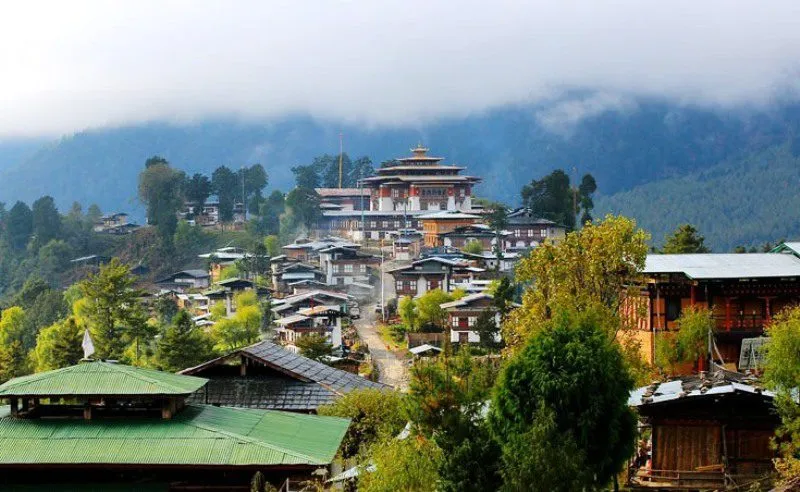
    From there, descend through rhododendron and conifer forest into Gangtey and the broad wetland floor of Phobjikha Valley.

    Visit Gangtey Monastery above the valley, then take a slow walk through the grasslands that shelter black-necked cranes each winter. Overnight in Gangtey.

  • Day
    03

    Gangtey to Bumthang via Trongsa

    A long and varied drive east through central Bhutan. Stop midway at Trongsa Dzong, the kingdom’s largest fortress and the ancestral home of the royal Wangchuck dynasty, the family that has ruled Bhutan since 1907.

    Climb over the Yotong La Pass before descending into the Bumthang valleys. By the time you arrive, the air is cooler, the light is cleaner, and the landscape feels older. Overnight in Bumthang.

  • Day
    04

    Sacred Temples and Legends of Bumthang

    We will spend a full day in the Choekhor Valley, visiting Bumthang’s most important sites. Jambay Lhakhang is believed to date to 659 AD, built by the Tibetan king Songtsen Gampo on the same day as 107 other temples across the Himalayas.

    Kurjey Lhakhang shelters a rock bearing the body imprint of Guru Rinpoche. Tamshing Monastery holds murals painted five centuries ago by Pema Lingpa, still sharp in color and detail.

    Finish at Jakar Dzong, the commanding fortress that watches over the valley. Overnight in Bumthang.

  • Day
    05

    Excursion to Remote Tang Valley

    Drive north into Tang, the least visited of Bumthang’s four valleys. The road narrows as it climbs, then opens into a wide pastoral basin where horses graze beside the river.

    The centerpiece is the Ogyen Choling Heritage Museum, a multi-story manor house preserved exactly as it was when a noble family lived and governed from it.

    Old thangkas, farming tools, manuscripts, and domestic objects tell a story of Bhutanese aristocratic life. Walk through the surrounding hamlets before returning to Bumthang.

  • Day
    06

    Day Trip to Ura, Bhutan’s Highest Village

    Cross the Ura La Pass to reach one of Bhutan’s most distinctive highland settlements. Unlike most Bhutanese villages, Ura is built in a tight cluster of houses that share walls, lanes are narrow and cobbled, and everything faces inward toward the central lhakhang.

    Walk through unhurriedly. Talk to residents. Watch a weaver at work or a farmer loading yaks. There is no agenda here beyond paying attention to a way of life that has resisted profound change. Return to Bumthang for the night.

  • Day
    07

    Scenic Drive West, Back to Gangtey

    Begin the return leg through central Bhutan’s highlands. The road west passes through familiar valleys, but with a different quality of attention, you know the landscape now and notice what you missed on the way out.

    Stop again at Trongsa if time allows, or pause on a ridge above the Mangde River gorge for views that reward a slow look. Arrive back in Gangtey by evening and overnight in the Phobjikha Valley.

  • Day
    08

    Gangtey to Historic Punakha

    Descend from Phobjikha’s cool plateau into the warmer valley of Punakha, Bhutan’s former capital and still the winter seat of the central monk body.

    Punakha Dzong sits at the precise confluence of the Pho Chhu and Mo Chhu rivers, its whitewashed towers and gilded roofs reflected in the water.

    Inside, courtyards and assembly halls decorated with fine woodwork and painted murals document five centuries of Bhutanese history.

    Walk across the suspension bridge downstream before dinner. Overnight in Punakha.

  • Day
    09

    Punakha to Paro via Dochula Pass

    Travel west once more over Dochula, catching the pass at a different time of day and possibly a different weather mood than before.

    Continue into Paro Valley—wider and more fertile than most, lined with willow trees and traditional farmhouses.

    Visit Kyichu Lhakhang, one of the country’s oldest temples and a deeply calm place to spend an hour.

    Stop at Ta Dzong, the circular watchtower that now houses the National Museum. The evening is free to explore Paro’s small town center. Overnight in Paro.

  • Day
    10

    Hike to Taktsang, Tiger’s Nest Monastery

    Start early and give yourself the morning. The trail to Taktsang climbs 900 meters through pine forest hung with prayer flags, with the monastery visible from the first viewpoint and drawing you upward for two hours.

    Cross the gorge on a narrow footbridge and enter the complex of temples and meditation chambers built into the cliff face.

    Guru Rinpoche is said to have arrived here on the back of a tigress and meditated for three months. Whether you follow the legend or not, the place is remarkable. Return to Paro for a final dinner.

  • Day
    11

    Departure from Paro

    After breakfast, our guide drives you to the airport for departure. Eleven days ago, you arrived not knowing quite what to expect.

    Most visitors find that Bhutan is not primarily about the extraordinary monuments but about encountering a country that has made deliberate choices about what to protect and what to let go.

    Those choices show in the landscape, in the pace of daily life, and in the people you meet along the way. Safe travels, and we hope to see you back.

Includes

  • Airport pick-up and drop-off by private vehicle
  • 3-star accommodation (4 & 5-star options available at additional cost)
  • Bhutan visa fee, including all necessary processing
  • Route permit for all destinations
  • Three meals per day during your stay in Bhutan
  • Our licensed Bhutanese tour guide for the entire journey
  • All land transportation by private vehicle
  • Sightseeing as per itinerary
  • All internal taxes and charges
  • Monument entrance fees, where applicable
  • Sustainable Development Fee of $100 per person per night (funds free education, healthcare, poverty alleviation, and infrastructure)

Excludes

  • International airfare and travel insurance
  • Expenses of a personal nature, tips to guides and drivers
  • Expenses arising from unforeseen events such as flight delays, road conditions, or weather

Additional Travel Info

Why can't I see the price for this tour?

Every trip to Bhutan is customized to suit your travel plans, so the tour price depends on several factors, including:

Number of travellers

Hotel category (3★, 4★, 5★ or Luxury)

Travel season and dates

Duration of your stay

Any special requests or customizations

To ensure you receive the best available price, please contact us with your travel requirements. We will prepare a personalized itinerary and send you a detailed quotation with no obligation.

Contact Details:

Email: info@tourinbhutan.com

WhatsApp: +1 401 328 1478 (WA Link)

Phone: +1 401 328 1478

Best Time for Bhutan Bumthang Cultural Tour

Spring (March to May) and Autumn (September to November) are the two recommended windows.

Both offer clear skies, comfortable daytime temperatures between 15°C and 25°C, and access to the main festival season. Spring brings rhododendron blooms across the passes. 

Autumn delivers golden valley light and the sharpest mountain views of the year.

Winter (December to February) is cold. Bumthang nights can drop below freezing but are peaceful and uncrowded.

Summer (June to August) brings the monsoon, which makes mountain roads slippery and visibility unpredictable. It is the least recommended season for this particular itinerary.

SeasonMonthsNotes
Spring ★ March – MayClear skies, 15–25°C, festival season starts 
Autumn ★Sep – NovemberGolden light, crisp mountain views 
WinterDec – FebruaryCold nights (below 0°C), quiet, crowd-free 
MonsoonJune – AugustHeavy rain, slippery roads—least recommended 

2026 festivals: Ura Yakchoe (Apr 28–May 2) · Kurjey Tshechu (Jun 24) · Tamshing Phala Chhoepa (Sep 21–23) · Jambay Lhakhang Drup (Oct 26–29). No separate entry tickets; festival access is included in the tour packages.

Gears, Equipment & Other Essential Things

Clothing & Footwear

  • Trekking pants and lightweight, breathable shirts (layer up)
  • Warm fleece or down jacket for evenings and high passes
  • Waterproof jacket and over-trousers
  • Comfortable hiking shoes with good ankle support
  • Warm socks; spare shoes for evenings
  • Scarf, gloves, and a wool hat
  • Modest dress for temples: full-length trousers or skirts, covered shoulders

Hiking & Outdoor

  • Daypack (20–30L) for daily excursions and the Tiger’s Nest hike
  • Trekking poles (optional but useful on uneven terrain)
  • Reusable water bottle with purification tablets
  • Wide-brim hat, sunglasses, and SPF 50+ sunscreen
  • Headtorch with spare batteries

Health & Pharmacy

  • Personal medications and a basic first-aid kit
  • Altitude medication—consult your doctor about Diamox before travel
  • Hand sanitiser and wet wipes
  • Lip balm and moisturiser (dry at altitude)
  • Insect repellent

Electronics

  • Universal power adapter (Bhutan uses Type C/D sockets)
  • Power bank and charging cables
  • Camera with extra memory cards and batteries
  • Binoculars: useful for mountain views and spotting black-necked cranes

Documents & Money

  • Passport with at least 6 months' validity
  • Bhutan visa approval letter (your operator will provide this)
  • Travel insurance documents (must cover medical evacuation)
  • USD cash: ATMs are limited outside Thimphu and Paro
  • Printed and digital copies of all key documents

Pro tip: Pack light but pack warm. Bhutan’s weather shifts fast at altitude. Layering is always more practical than one heavy coat.

Accommodation 

Throughout the tour, you stay in 3-star boutique hotels and heritage lodges selected for character, location, and local ownership. These are not international chain hotels. They are properties with wooden interiors, traditional motifs, valley views, and staff who have been in the same valley their entire lives.

All rooms include en-suite bathrooms, hot water, heating, and Wi-Fi. Meals are served on-site and combine Bhutanese home cooking with continental options.

  • Thimphu: Boutique hotel in the capital, central location, mountain views
  • Gangtey: Eco-lodge overlooking Phobjikha Valley and the wetlands
  • Bumthang: Heritage-style lodge in the Choekhor Valley, walking distance to temples
  • Punakha: Riverside resort below the Dzong, warm valley setting
  • Paro: Traditional farmhouse-style property in the valley, near Tiger’s Nest trailhead

Exact properties may vary based on availability. We maintain high standards of comfort, cleanliness, and cultural character throughout. 4-star and 5-star options are available on request.

Travel Tips for Bhutan

  • Visa & SDF: All non-Indian, non-Bangladeshi, and non-Maldivian visitors require a Bhutan visa processed through a licensed operator. The Sustainable Development Fee is US$100 per person per night (children under 12 are usually exempt or discounted). The visa fee is approximately US$40.
  • Getting There: International flights arrive at Paro Airport via Drukair or Bhutan Airlines. Main connections from Bangkok, Delhi, Kathmandu, Dhaka, and Singapore. Book early, as seats are limited.
  • Currency: Bhutanese Ngultrum (BTN) is pegged to the Indian Rupee (INR), and INR is widely accepted. Cards are limited outside Thimphu and Paro; carry sufficient USD or INR cash.
  • Health & Altitude: Bumthang sits above 2,600m. Drink plenty of water, avoid alcohol on your first night, and walk slowly on arrival. Consult your doctor if you have any respiratory concerns.
  • Temple Etiquette: Remove shoes and hats before entering any temple or dzong. Photography is often restricted inside sacred spaces; always ask your guide first. Dress modestly.
  • Tipping: Not mandatory, but genuinely appreciated. A standard daily tip is USD 10–15 for your guide and USD 5–8 for your driver.
  • Food: Bhutanese cuisine centers on red rice, buckwheat, and chili-heavy dishes. Ema Datshi (chili and cheese) is the national dish. Vegetarian options are always available. The locally brewed ara (rice wine) is worth trying once.
  • Connectivity: SIM cards with data are available at the airport. Wi-Fi is reliable at most hotels. Connectivity in the Tang and Ura valleys may limit access.

Book Your Trip 

Ready to go? Tell us your dates, group size, and anything specific you’re hoping to see or do. We’ll take care of the rest: visa processing, permits, accommodation, guides, and every detail in between.

Here’s how it works:

Share your dates → receive a full quote → confirm with a deposit → we handle the visa → you arrive ready to travel.

Booking 30–60 days ahead is recommended and earlier if you want to coincide with a festival. Peak season (October–November) fills quickly.

We’ve been taking people into Bhutan’s most meaningful places for years. We’d be glad to do the same for you.

Trip Reviews

[trustindex no-registration=google]
TripAdvisor
Rated Excellent by our travellers
★★★★★
"Best Bhutan Tour Operator"
"Aura Trails made our Bhutan trip absolutely unforgettable. Every detail was perfectly planned."
Sarah M.
Australia · Cultural Tour
TripAdvisor
★★★★★
"Exceeded All Expectations"
"From landing in Paro to our last day in Thimphu, everything was seamless. Highly recommend!"
James K.
USA · Trekking Tour
TripAdvisor
★★★★★
"A Dream Come True"
"The festival tour was magical. Our guide Karma was exceptional — so much local knowledge and warmth."
Emma L.
UK · Festival Tour
TripAdvisor
Read All Reviews on TripAdvisor →